


Center for
Responsible Forestry

All in for the Elwha Watershed!
Time for State Action

Voice Your Support
for the Elwha Watershed!
For thousands of years, the Elwha Watershed has sustained people and an extraordinary diversity of life. Today, we have an opportunity to sustain the Elwha Watershed for generations to come. CRF has been partnering with Earth Law Center and the Elwha Legacy Forests Coalition to find the best ways to do just that.
As the site of one of the largest ecosystem restoration efforts in American history, the Elwha has become a remarkable story of recovery. Now, the Washington State Department of Natural Resources has an opportunity to protect and restore the state-managed lands that support the Elwha Watershed.
Protecting these lands would help secure decades of investment in Elwha River restoration while safeguarding older forests, rare habitats, tributaries, wetlands, and other extraordinary natural areas that support salmon, water resources, biodiversity, cultural values, recreation, and the continued recovery of the watershed.

Washington is now approaching an important decision for the Elwha Watershed!
The Department of Natural Resources is completing a legislature-directed assessment of DNR-managed lands in the watershed and identifying lands appropriate for conservation as a Natural Area Preserve or Natural Resources Conservation Area. DNR’s recommendations to the Legislature are due Dec. 1 of this year.
Our coalition has prepared a letter to Commissioner of Public Lands Dave Upthegrove encouraging DNR to recommend the most robust conservation package possible for the Elwha Waterhsed. Please add your name.

New Report:
“Elwha Watershed Protection — A Call for State Stewardship”
A new report makes the case for Elwha Watershed protection. To help inform this important decision, the Center for Responsible Forestry, Earth Law Center, Earth Economics, the Elwha Legacy Forests Coalition, Legacy Forest Defense Coalition, and a team of scientists, botanists, lichenologists, and other experts have completed a comprehensive 65-page conservation assessment of DNR-managed lands in the Elwha Watershed.
Elwha Watershed Protection — A Call for State Stewardship brings together new field surveys, forest mapping, wildlife and habitat data, scientific research, recreation and cultural values, water resources, and economic analysis to provide a more complete picture of what is at stake.
You can download the PDF document by clicking here.

We discovered remarkable
biodiversity—some of it
previously undocumented.
In spring 2026, field teams surveyed 1,548 acres, documenting rare plants and lichens alongside caves, old-growth trees, cliffs, globally rare bald habitat, and other significant natural features.
Most remarkably, the surveys discovered a previously unknown population of the federally and state endangered Taylor’s checkerspot butterfly in the Mount Sutherland area, subsequently verified by the Washington Department of Fish and Wildlife.

Surveys also documented a previously unknown population of endangered lichen, populations of threatened lichen, and numerous sensitive plants and lichens.
The broader landscape also provides habitat for marbled murrelets, Pacific fishers, western toads, harlequin ducks, rare bats, and many other species of conservation concern.
Together, these discoveries reveal both the extraordinary biodiversity of the Elwha Watershed and how much there still is to learn about these lands.
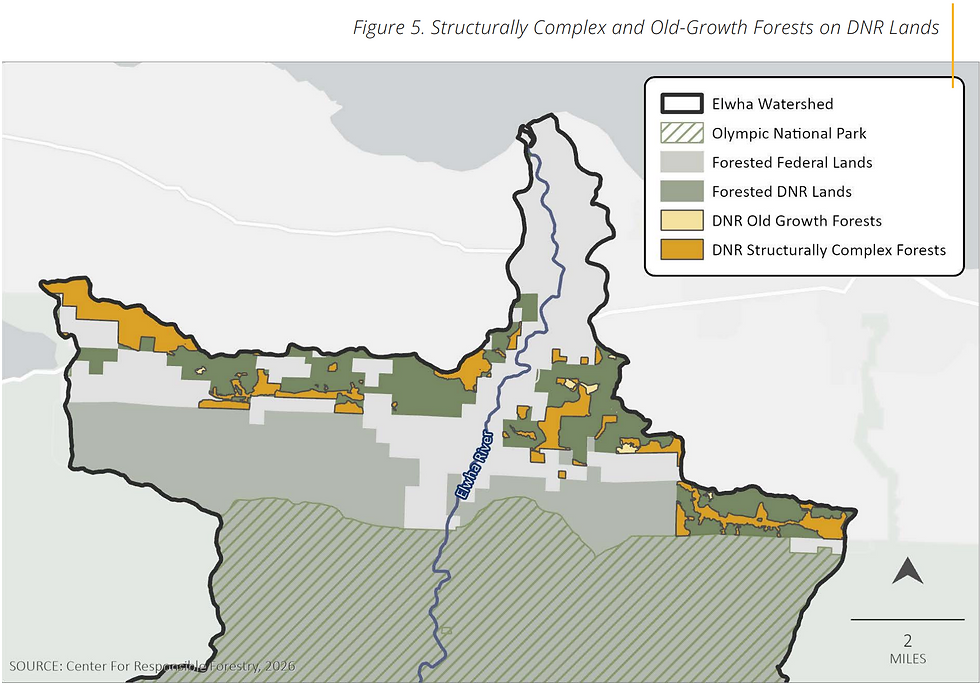
We found that some of the Elwha Watershed’s most important forests remain unprotected.
DNR manages approximately 7,358 acres in the Elwha Watershed, including roughly 2,787 acres of structurally complex forest. Approximately 882 acres of these forests remain unprotected.
They are an integral part of the living infrastructure that supports the Elwha Watershed—and those functions are especially important because, despite the Elwha’s remarkable progress, the watershed still faces significant challenges.

These older forests are much more than collections of trees. Their layered canopies, large root systems, forest soils, standing snags, and downed wood provide complex habitat while supporting water supply and summer streamflow, water quality, flood mitigation, drought resistance, carbon storage, aquatic habitat, biodiversity, and soil stability.
We found that the Elwha’s recovery is underway—but significant water challenges remain.
The removal of the Elwha dams launched an extraordinary restoration effort, but the work is not finished. The report notes that water temperatures in the Elwha Watershed exceed Clean Water Act standards, while impaired waterways remain within the study area. The Elwha River is also the sole water source for the City of Port Angeles and supplies roughly 25% of Clallam County, making watershed health directly connected to community water security.

Looking ahead, the challenge becomes even greater. Washington Department of Ecology modeling cited in the report projects 20–40% declines in late-summer streamflow within the next 20 years and 40–60% declines by 2100 in the Elwha-Dungeness region. Potential impacts identified in the report include impaired fish spawning and rearing, water-supply shortages and curtailments, and decreased groundwater levels and reliability.
These findings are an important reminder that removing the dams was not the end of Elwha River restoration—it was the beginning of a much longer process. Protecting and restoring the forests, tributaries, wetlands, floodplains, and other natural systems that help regulate and sustain water is an important part of carrying that recovery forward.
We found that protecting these forests also provides substantial economic benefits.
An analysis by Earth Economics estimates that protecting the structurally complex forests would provide approximately $367.5 million more in ecosystem-service benefits over 120 years than the modeled harvest scenario.
Those benefits include water capture and supply, habitat conservation, outdoor recreation, carbon sequestration, disaster-risk reduction, erosion regulation, pollination, and seed dispersal.


And these benefits extend from the forests to salmon—and all the way to Southern Resident orcas.
The Elwha Watershed is one interconnected living system. Its forests, tributaries, wetlands, floodplains, river, estuary, and nearshore waters all contribute to the continued recovery of the watershed.
Recovering Elwha salmon also helps support endangered Southern Resident orcas, and NOAA has identified the Elwha River as a top restoration priority for their recovery.
Taken together, these findings point toward something much larger than protecting individual forest stands: an opportunity to protect and restore the Elwha Watershed as an interconnected watershed and carry forward the remarkable recovery already underway.
Photos from Our Report's Lichen & Rare Plant Survey


